


Hurricane Season on the Crystal Coast: What to Move to Storage, and When
If you've lived on the Crystal Coast for more than a season or two, you already know the drill. The cone shows up on the news. Everybody starts checking the same three weather apps. And somewhere around 72 hours out, the plywood and the bottled water disappear from the shelves.
What most people don't plan for is the stuff that can't be nailed down or stuffed in a closet — the kayak, the golf cart, the boxes of photo albums in the crawlspace, the patio set that turns into a projectile at 90 miles an hour.
Here's a practical guide to what's worth moving, and the timeline that keeps you from scrambling.
First: the calendar you're actually working against
Atlantic hurricane season runs June 1 through November 30, and for Carteret County the heart of it is mid-August through early October. That's when sea surface temperatures peak and the classic Cape Verde storms come off the African coast with two weeks to organize.
The important thing to understand is that storage availability drops fast once a named storm enters the forecast cone. Everyone in Beaufort, Morehead City, and Atlantic Beach has the same idea at the same time. If you wait for the watch to be issued, you're competing with a few thousand neighbors for whatever's left.
The people who handle this well rent in June or July and treat it as cheap insurance for the season.
What's genuinely worth moving
Not everything needs to leave your house. Focus on three categories.
1. Things that become projectiles
Wind is the part people underestimate. A patio chair at tropical storm force is a wrecking ball headed for your neighbor's window — and depending on your policy, that can become your problem.
● Patio furniture, umbrellas, and cushions
● Grills and propane tanks (tanks should never go into a storage unit — more on that below)
● Kayaks, paddleboards, canoes
● Bikes, scooters, wagons
● Potted plants and planters
● Garden decor, wind chimes, flags
● Trash and recycling bins
2. Things that can't be replaced
Flood water is the real destroyer on the coast, and it doesn't care whether you're in a flood zone on paper. Storm surge and rainfall flooding regularly reach places FEMA maps call low risk.
● Photo albums, negatives, film
● Birth certificates, passports, deeds, titles, insurance policies
● Family heirlooms, jewelry, antiques
● Artwork and instruments
● Backup drives, old computers with data you'd miss
● Military records and discharge papers
If you store nothing else, store this box. Then take photos of every document with your phone as a second backup.
3. Things that don't handle water or humidity
● Upholstered furniture and mattresses
● Wood furniture, especially anything veneered
● Books, vinyl records, sheet music
● Electronics and small appliances
● Anything currently living on a garage floor or in a crawlspace
What you should not put in a storage unit
Every facility has these rules, and they exist because of fire risk and liability. At Store My Things Beaufort, and essentially anywhere else:
● Propane tanks, gasoline, kerosene, generators with fuel in them. Drain the mower and the generator before they go in.
● Fireworks, ammunition, or explosives
● Perishable food, including pet food (it attracts pests, which become everyone's problem)
● Live plants or animals
● Anything wet — a damp kayak cover in a sealed unit turns into a mold farm
Store your generator, absolutely. Just empty the tank first and store the fuel safely at home in an approved container.
The timeline
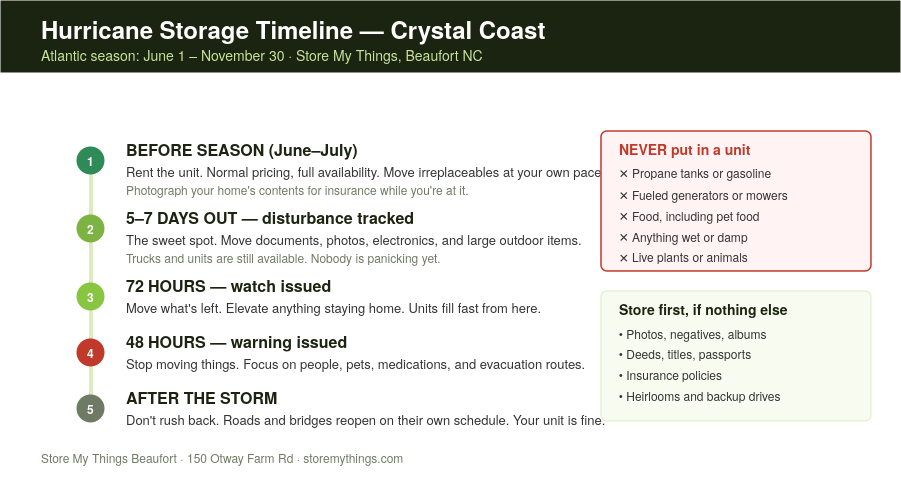
Now, or any time before a storm is named
Rent the unit. Prices and availability are normal, and you can move things over at a relaxed pace across a couple of weekends. Photograph your home's contents for insurance while you're at it — room by room, open the closets and cabinets.
5–7 days out (a disturbance is being tracked)
This is the sweet spot. Move the irreplaceables and the big outdoor items. Nobody's panicking yet, and you can still get a truck.
72 hours out (watch issued)
Move anything left. Elevate whatever stays home — furniture on blocks, boxes off the garage floor, electronics unplugged and up high.
48 hours out (warning issued)
Stop moving things. Focus on people, pets, and evacuation routes. Your stuff is a distraction at this point.
After the storm
Don't rush back to the unit. Roads and bridges into Beaufort often stay closed for days, and the causeway backs up badly when they reopen. Your unit isn't going anywhere.
Why climate control matters more here than almost anywhere
Coastal North Carolina puts three things on your belongings at once: heat, humidity, and salt. Average summer humidity on the Crystal Coast sits well above 75%, and salt air accelerates corrosion on anything metal — hinges, tools, bike chains, electronics, instrument strings.
A standard drive-up unit is the right call for a lot of items. But for photographs, electronics, upholstered furniture, wood, leather, and instruments, climate-controlled space is genuinely worth the difference. Humidity is what warps furniture and blooms mold, and it does its damage slowly enough that you don't notice until you open the door in April.
We break down the decision in more detail in Climate-Controlled vs. Standard Storage.
A few coastal-specific tips
Pallets are your friend. Even inside a unit, get boxes off the concrete. Cheap plastic pallets or a couple of 2x4s work fine.
Skip cardboard for long-term coastal storage. Cardboard wicks moisture and it's a pest magnet. Clear plastic totes with gasket lids cost more up front and save you a lot of grief.
Silica gel and moisture absorbers. A few DampRid tubs in a unit make a real difference over a humid summer.
Photograph everything as you load it. Insurance claims go dramatically better with photos and a rough inventory list.
Check your policy before you need it. Most homeowners and renters policies extend limited coverage to belongings in storage — often around 10% of your contents limit. That may or may not be enough. Ask your agent specifically about off-premises coverage, and ask whether flood is excluded, because it usually is.
Store My Things Otway Storage - Beaufort, NC
We're at 150 Otway Farm Rd, just off the causeway and easy to reach from Beaufort, Morehead City, Atlantic Beach, Newport, and Harkers Island. Drive-up access, security fencing, property lighting, and online rental so you don't have to wait for office hours to lock in a space.
If a storm is in the forecast and you're trying to figure out what size you need, our size guide has short videos for every unit — a 5x10 handles a patio set and a few dozen boxes, and a 10x20 will take a household's worth.
Stay safe out there. The stuff is replaceable; you're not.

